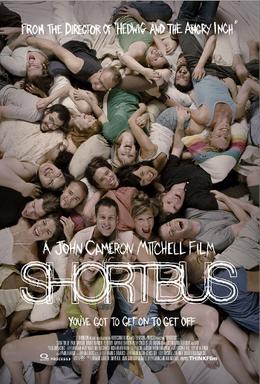
John Cameron Mitchell’s Shortbus has long been treated as a cult object of queer, sex‑positive cinema: a utopian New York sex salon, unsimulated sex, and a collaborative ensemble that supposedly dissolves the line between actor and character.
On paper, this sounds like the kind of film I should champion. After years of horsing around dungeons and hosting kink parties, I have a very high threshold for weird sex on screen.
In practice, watching it in 2026, I find myself in an exhausting effort to suspend disbelief. It’s the way the film sells itself as a queer utopia of “we’re all freaks together” while quietly turning one racialized woman’s body into the sexual workhorse that keeps the whole thing running.
Recently I wrote about Harry Lighton’s Pillion, a film that split my own leather circle over whether a film’s honesty about power is a gift or a wound. With Pillion, the fault line ran between people who read Ray as a tragic, myth‑making Dom in progress, and people who simply said, “I never thought he was a good guy.” I argued there that kink on screen can’t be reduced to such binary narratives; we have to hold space for how different kink histories read the same scenes.
I want to bring that same generosity and suspicion to Shortbus. But I find myself stuck, because here the exploitation feels less ambiguous.
The Queertopia as Myth & Marketing
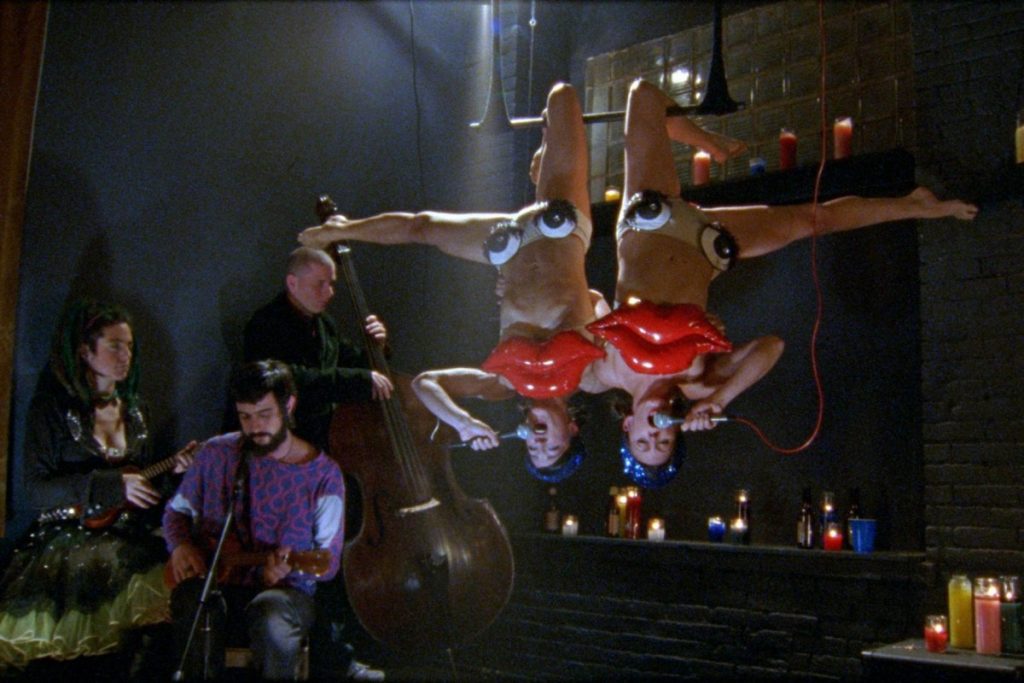
In Pillion, Ray built himself a myth around conquest, fealty, and a tribe forged out of chrome and leather. Shortbus runs on its own myth: the sex club as a democratic, “gifted and different” utopia where everyone’s wound gets tended by communal intimacy. Both myths are seductive because they promise a truer, more authentic way of living than the compromises everyone else settles for.
Shortbus also marketed the film’s creation as another myth: a multi‑year workshop process, non‑professional performers, characters drawn from the cast’s real sexual histories, everyone agreeing to have real sex on camera. It’s the dream scenario for a certain liberal, sex‑positive imagination: collaboration, consent, authenticity. You can practically feel the grant applications writing themselves.
But myths need someone to carry their weight. Ray’s tribe needed Colin’s devotion to function; Shortbus’s utopia needs somebody to be the proof that liberation works. So when the credits tell me the cast helped create their characters, I hear two things at once. My sex‑positive side hears, “Good, they weren’t just meat.” My critical side hears, “Okay, but whose fantasy did that labor ultimately serve?”
After all, collaboration inside a strongly authored project doesn’t abolish hierarchy; it just makes it feel more intimate. John Cameron Mitchell still sets the premise, convenes the room, chooses what to shoot, and dictates the final edit. The ensemble can improvise all they like; what we see is the version that fits his narrative of wounded New Yorkers healed by a magical sex salon.
Sofia and the Orientalist Fog
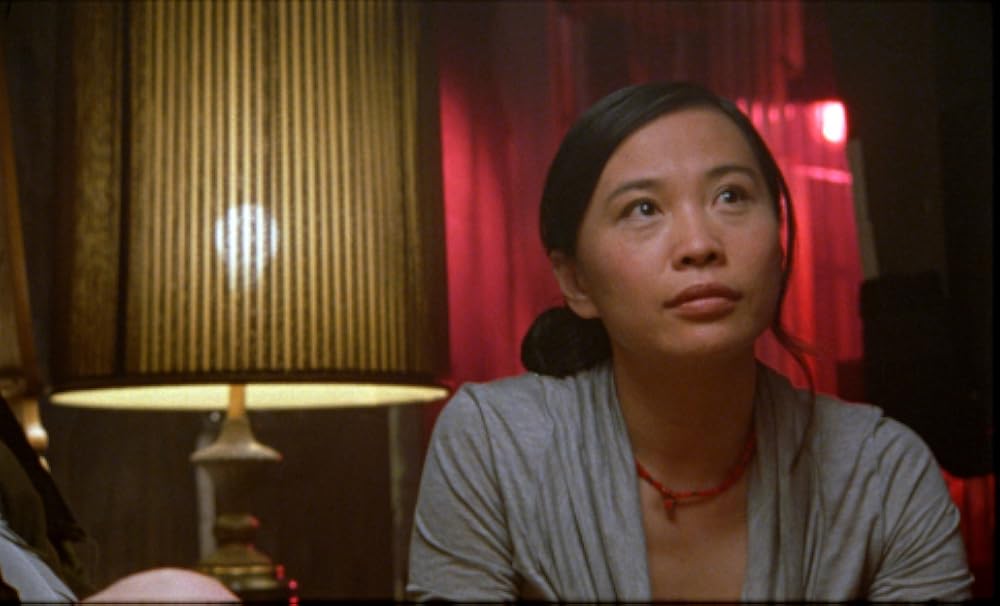
Enter Sofia, played by Sook‑Yin Lee: Chinese‑Canadian, couples therapist and sex therapist, married to a white husband, never had an orgasm. Raised by strict parents, intellectually overdeveloped, bodily “blocked.” The plot sends her to Shortbus as a patient in search of real pleasure.
If we pretend race isn’t a thing, this is familiar indie fodder: the over‑functioning professional who can fix everyone else but not herself, the sex‑expert with no access to her own desire. But I don’t get to pretend race isn’t a thing. I’m watching this as a kinky Asian in a culture saturated with fantasies about what we are and are not allowed to feel.
On an Asian woman, Sofia’s mix of filial trauma, emotional tightness, and sexual inability doesn’t read as neutral. It lands like a remix of an old Orientalist track: the hyper‑controlled, “good” Asian girl whose icy exterior hides untapped erotic depths just waiting for the right savior. The film frames this as a quirky, individual neurosis. My brain reads it as a type.
The problem isn’t that Shortbus has an Asian character with complicated sexual issues. The problem is how comfortably those issues line up with a long history of racialized scripts about who is “naturally” repressed and who gets to be the one doing the liberating.
Sofia as Generator: Reclaiming the Stereotype
At the same time, I don’t want to deny Lee credit where it’s due. Sofia isn’t just trapped inside the “blocked Asian” stereotype; she also overloads it until it breaks. The film quite literally ties her sexual frustration to a city‑wide blackout, then frames her eventual release as the moment electricity and light surge back into New York. Her “too much” feeling doesn’t just fix her marriage; it rewires the whole diegesis. That’s not nothing.
Read that way, Sofia’s arc becomes a reclamation: the same racialized figure who’s coded as repressed is revealed to be the sovereign generator of power. The stereotype of the cold, over‑disciplined Asian woman is pushed so far into mythic, infrastructural consequences, that it curdles into something else: a body whose desire is so intense the grid can’t contain it, and whose orgasm becomes the condition for everyone else’s healing. Lee leans into the trope hard enough that she can twist it, turning “frigid” into “world‑altering.”
This doesn’t cancel the Orientalist fog; the film still asks an Asian woman to embody repression and release for a mostly non‑Asian audience. But it does complicate a straightforward Orientalist critique. Sofia is not just an object of liberation. She’s the one whose internal storm knocks the city offline and back on again. That’s a reclamation worth naming alongside the exploitation.
The Sexual Workhorse
What really makes my stomach drop is the division of labor. In a film that loudly insists “we’re all doing real sex here,” Sook‑Yin Lee ends up doing more of the heavy lifting than almost anyone else. She’s there for unsimulated hetero sex, for lesbian encounters, for nonconsensual remote sex, for multiple masturbations. Other characters are explicit, yes, but Lee’s body is the multi‑tool: if the film needs a different configuration of “real sex,” chances are she’s the one supplying it. She becomes the sexual workhorse of the ensemble, the reliable body the movie can ride the farthest.
As a kink‑affirming viewer, I’m not concerned by the explicit scenes. What I can’t overlook is the pattern: in this supposedly egalitarian utopia, it’s the Asian woman whose body is made maximally available, maximally versatile, maximally useful to the project’s claims about authenticity.
And then you step outside the film, and it gets worse. Her scenes are clipped, reframed, tagged, and circulated on porn sites as “Asian” content, as “mainstream actress doing hardcore in that art film.” Whatever experimental or communal dreams Shortbus had, the market has converted Lee’s labor into racialized porn, endlessly replayable. She said yes to a risky, collaborative film; she did not personally consent to becoming a genre.
And yet, I don’t want to erase the ways Lee might also be reclaiming that script. The film literalizes Sofia’s frustration into city‑scale infrastructure: her blocked desire is tied to a blackout that blankets New York, and her eventual release is framed as the return of electricity and light. That’s a wild, mythic upgrade for a figure who usually gets stuck as “frigid Asian therapist.” Her excess feeling doesn’t just make her interesting; it shorts out the grid. Read this way, Lee is overidentifying with stereotype until it tips into sovereignty: the woman you thought was powerless turns out to be the generator. The same scenes that feed a porn economy also anchor the film’s fantasy of collective healing, and that ambivalence belongs to her too.
Consent Isn’t the End of the Question
With my kink background, I take consent very seriously. I also know that “they agreed to it” is the floor of an ethical conversation, not the ceiling.
Lee was not a powerless newbie. She walked into this project as an established Canadian artist with a long record of pushing against sexual respectability. I believe she wanted to do something radical. I don’t doubt her agency. That matters.
But structures of race, gender, and capitalism don’t evaporate in the face of individual agency. They shape which risks get offered to whom, how those risks pay off, and who carries the long‑term costs. A white actor’s explicit work in Shortbus lives mostly inside the film’s indie‑cult reputation. Lee’s explicit work has a second life as searchable “Asian” hardcore, as a curiosity to be consumed by people who couldn’t care less about the film’s tender politics or queer intentions.
Lee’s consent to the project cannot be read as a blanket permission for the structural forces shaping the film’s afterlife, the same way Ray’s “you can leave” line was formally free and functionally hollow for Colin in Pillion.
So when I say the film exploits her, I don’t mean “she was tricked.” I mean: the combination of director’s vision, racialized fantasy, and porn economy extracts more from her body than from many of the bodies around her. The sexual workhorse pays more than the show ponies.
Watching With Love and Suspicion
I’m not interested in purging Shortbus from the queer film canon any more than I wanted to flatten Ray into a cartoonish villain. There are moments I still find deeply moving: stray glances, clumsy jokes, bits of community that feel lived‑in rather than designed. I respect Sook‑Yin Lee as an artist who made a difficult choice in an attempt to expand what’s possible on screen.
But I notice how often Lee’s naked labor is what makes the film feel “brave,” how much of its sex‑positive aura flows through an Asian woman’s willingness to be used as proof of concept. I let that discomfort stay sharp instead of smoothing it over with “but they all consented” or “it was collaborative.”
Maybe that’s what adult, queer, sex‑positive criticism looks like in 2026: not cheering for any film that shows real sex, but asking, every time, whose body is doing the work, whose fantasies are being serviced, and who gets ridden the hardest on the way to utopia. And, in cases like Lee’s, how that same body might also be hijacking the stereotype to steal a little power back.
-
When Utopias Haunt Shortbus (2006): Myths, Orientalism, and Sook‑Yin Lee
Shortbus (2006) has a cult reputation as a bold, queer, sex‑positive classic, but […]
-

Reading Ray: A Kink-Affirming Analysis of Pillion (2025)
A queer, kink-affirming, trauma-informed reading of Ray in Pillion (2025)– part tragic Dom, […]
-



No responses yet