This is not a neutral Project Hail Mary review. It is an essay about the film’s politics: how a supposedly apolitical, family‑friendly, “not woke” sci‑fi blockbuster about Ryan Gosling’s Ryland Grace quietly flatters tech‑bro rationalism, evangelical Christian sensibilities, and conservative culture‑war fantasies while insisting it is just wholesome fun.
Project Hail Mary is the kind of movie that wants to feel wholesome: a plucky science teacher in space, an adorable rock alien, faith in human ingenuity and cross‑species friendship. I went in ready to let it be that: popcorn, spectacle, a little tear at the end to share with pup buds. Instead, I left with the odd sensation that the film had been patting me on the head for two and a half hours: an impact scene with false promise and shaggy execution.
Its cosmos is built on star‑eating mold (“Astrophage”) and a perfect microscopic predator (“Taumoeba”); its theology is built on name-dropping “Hail Mary,” grace, and Eve; its politics are built on a white American boy saving two worlds while a “diverse” supporting cast makes his heroism look inclusive. All the while, it keeps insisting it’s “not political,” just a good story.
The result is less an honest sci‑fi fable than a conservative comfort object: a movie perfectly calibrated to soothe tech‑bros, evangelicals, and anti‑“woke” culture warriors who want to believe science can stay apolitical while a few Bible‑adjacent names and a straight cis white “vaguely Jesus-looking” dude still gets to be grace incarnate to save the galaxy.
The Astrophage/Taumoeba plot captures the binary thinking in Project Hail Mary’s science fiction worldbuilding. Astrophage is framed as a star-eating cosmic pest, an invasive blight that threatens the energy order on which human and Eridian life depends, while Taumoeba is introduced as its “natural predator”, the corrective that will restore balance. This is not just thin biology. It reproduces a pest-control imaginary in which forms of life become legible only through narrow, anthropocentric lens. There is no attention to ecological depth, co-evolution, or the politics of deciding which life forms count as expendable.
As someone who has spent years thinking about how “pest” is a manufactured category. it’s hard not to watch Project Hail Mary as a cosmic pest‑control training video. It’s not just bad biology; it’s a fantasy of hygienic violence, scaled up to the stars. “Pest” is never a self-evident term, but one laden with a complicated global history entangled in realms from agriculture, environmental management, biomedicine, public health, to propaganda, carrying with hygienic violence and heuristics of simplified moral sorting. The film does not need to announce any of this to participate in it. It just stages a universe in which the right response is technocratic control by a genius fixor.
It is, in other words, the fantasy of a certain Silicon Valley rationalist: a world reduced to legible pests and clean fixes, where complex ecologies and histories can be debugged by a single brilliant man with the right tools, and all the messy politics of who lives and dies disappear into “optimal problem‑solving.”
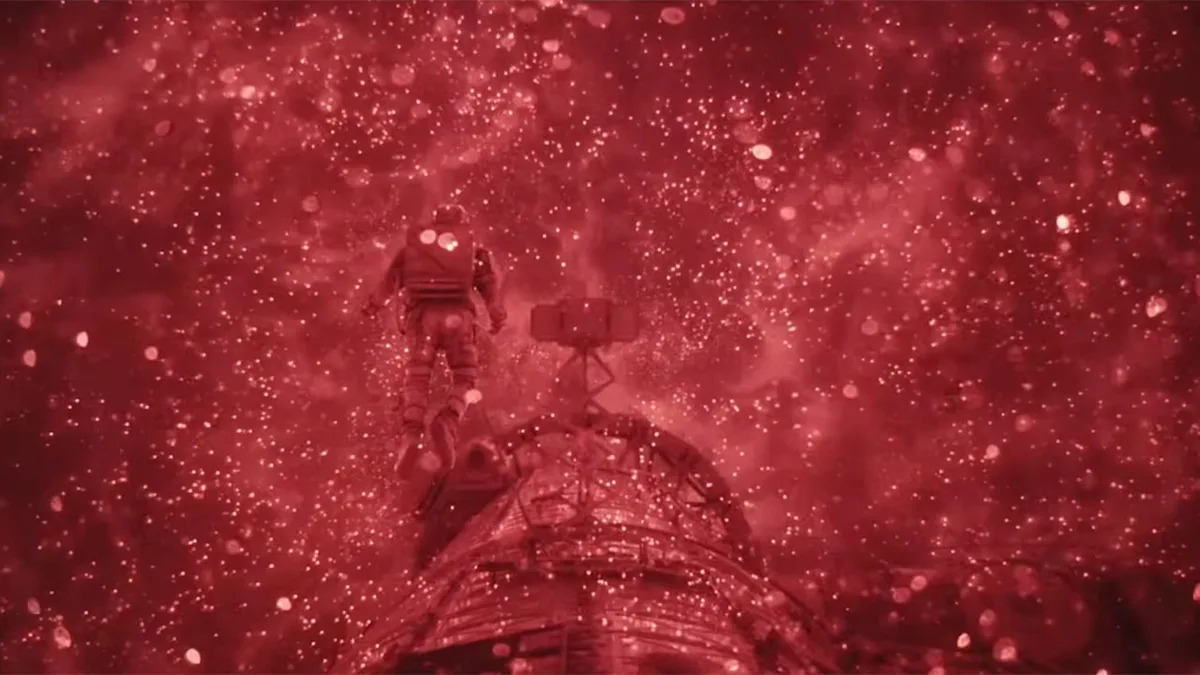
Move still showing the Astrophage swarm in the Tau Ceti’s Petrova line towards planet Adrian. Source
There is one moment when the film seems to strain against its own pest cosmology. When Grace steps outside the Hail Mary inside Tau Ceti’s Petrova line—“having a moment”—the astrophage appears not as a spreadsheet problem but as a swarm of space fireflies, a shimmering, engulfing field of alien life that briefly invites wonder rather than extermination.
For an instant, the microbe is allowed to be sublime and non-instrumental, something other than a pest awaiting its predator. And then the story snaps back: Astrophage returns to its role as cosmic blight, Taumoeba to its function as “natural enemy,” and the fireflies become just another visual metaphor for a problem to be solved by the designated hero.
Even the way the film looks insists on this shallow binary. Astrophage is rendered as black goo or black particulate matter, a perfect absorber that appears as darkness under magnification and as a stain on stellar life, while Taumoeba, its “natural enemy,” is coded as pale, clean, nearly translucent. This is not neutral design. It taps a familiar moral palette in which danger and contamination are dark, cure and salvation are light, and science exists to reinstate a bright, orderly cosmos by erasing the black blight. The visual ecology therefore mirrors the narrative one: alien life is translated back into human binaries—good and evil, pure and impure, problem and cure—rather than allowed to remain genuinely strange.
The same logic shapes the film’s treatment of race, gender, and theology. The Christian symbolism is impossible to miss—“Hail Mary,” Grace, Eva/Eve, the casual invocation of God as “better than the alternative,” even the “vaguely Jesus-looking astronaut”—but these feels like a nervous college frosh sprinkles citation without engaging the argument. These gestures sanctify the mission in advance, giving the story the glow of providence without the burden of real theological or ethical difficulty. This ain’t theology; it’s name‑dropping religion to make a conservative rescue fantasy feel profound. No wonder so many Christian outlets rave about the film.
For some reviewers, this is enough to ask whether Project Hail Mary is a “Christian movie.” For a certain evangelical audience,it offers the best of both worlds: a “clean,” non‑sexual space epic that name‑checks God, grace, and sacrifice, but never asks what any of those words might demand of the people shouting them. It reassures them that their cosmology still underwrites the universe, even in a story that pretends to be purely about science.
Alongside that, the film offers visible but shallow diversity clustered around a familiar center. A white American man remains the indispensable bearer of ingenuity, sacrifice, and moral weight, while women and characters of color are granted competence, a few sharp beats, and little interiority. The story depends on their expertise and labor but rarely pauses to imagine what the crisis looks like from where they stand. Diversity becomes window dressing for a universe in which grace and heroism still flow through the same old body.
The reception of the film makes this even harder to ignore. Alt‑right influencers and more respectable conservative‑coded outlets alike have celebrated Project Hail Mary as proof that audiences still want a straight cis white male hero, minimal overt politics, and “traditional” storytelling. Fox News praises it as an “anti-woke Hollywood blockbuster,” calling on Hollywood to “take lessons.” Author Andy Weir’s own insistence that he avoids politics and messaging has only fueled that response.
The film’s supposed apoliticality is precisely what allows viewers to experience its hierarchies as natural rather than ideological. For the anti‑“woke” crowd, that feels like vindication: here, finally, is a blockbuster that proves you can still center a straight white American man, scrub out explicit politics, drape the whole thing in God talk and national flags, and call it “for everyone.”
This is why the movie’s much-praised neutrality feels so evasive. It is not neutral at all. It offers a comforting package of civilizational rescue, technocratic management, Christianized symbolism, and window-dressing diversity, all organized around the reassuring fantasy that history, ecology, and politics can still be redeemed by the right white boy in the right crisis.
National Flags and Selective Visibility
Even the mission patch tells on the film. In the story, Grace’s original crewmates are explicitly presented as coming from China and Russia, and the mission itself is described as a rare instance of global cooperation under catastrophic pressure. Yet the official visual logo features a ring of national flags that conspicuously omits both China and Russia, while still prominently displaying the U.S., Japan, several European states, Brazil, Canada, South Korea, India, and others.
The repeatedly featured Project Hail Mary logo in the film. Source
Industry reporting has attributed the issue to Hollywood compliance requirement: every national flag requires permission, some governments wanted to approve placement and adjacency, and not all of them signed off in time. That’s the official explanation for a repeated featured logo—and a set of marketing images—in which certain nations’ symbols vanish while their citizens’ bodies remain usable on screen. Project Hail Mary likes the idea of cooperation with Chinese and Russian astronauts, but it is reluctant to fully foreground their political symbols. The global mission is narratively dependent on their presence, yet the visual language of the film still circles back to a familiar Western‑led imaginary of “the world” that can be shown, celebrated, and sold.
Watching With Love and Suspicion
Project Hail Mary presents itself as uncomplicated entertainment: a fun science puzzle, a buddy movie with an alien, a story about competence and sacrifice under pressure. But the film’s apparent neutrality is itself ideological. Its world only works by relying on a set of remarkably blunt categories (pest and predator, problem and solution, grace and salvation, central hero and supporting cast) and then treating those categories as natural rather than historically constructed.
Alleged original design of the logo that features more national flags. Source.
I don’t want to pretend Project Hail Mary is worthless. The firefly-like Astrophage flux in the Petrova line is awe-inspiring; Rocky is one of the most endearing aliens to hit the screen in years; and there is a real pleasure in watching people cooperate instead of guarding against each other in a vicious jungle.
But pleasures have politics. When a film this adored packages white‑boy grace, black‑goo pests, pale‑white predators, and carefully curated flags as “neutral,” it tells us less about the cosmos and more about what kinds of stories we still find comforting: stories where tech‑bros get solvable problems, evangelicals get thinly veiled providence, and the alt‑right gets a “non‑woke” hero who proves nothing fundamental ever had to change.
That’s not a call to boycott it. It’s a reminder to watch it with the same love and suspicion we bring to kink fables like Pillion (2026) and queer utopias in Shortbus (2006), and to ask, once again, whose myths are doing the work, and who gets ridden the hardest on the way to salvation.




No responses yet