Harry Lighton’s Pillion is sexy, fun, smart, and unexpectedly wounding. I saw the film at the Chicago premiere with a row of leather friends, then went back twice more, and spent the weeks after in group chats, blogs, and Mastodon threads trying to make sense of why it landed so hard.
Some see their stories being told empathetically for the first time on a big screen. Others walk out frustrated feeling it’s yet another story in which kink is just abuse with better lighting. The split isn’t abstract for me. Some of my friends land firmly on the “Ray is toxic” side. Chris, a pup friend who spent ten years in a D/s relationship, reads Ray straight up as “the antagonist” of the film and “a shit Dom,” and I take that seriously because it’s rooted in his own history in kink, not theory. Mr. Q, another long‑time lifestyle sub, has written about the “kink civil war” the film has provoked: scene‑based kinksters tend to see Pillion as a case study in bad consent, while identity‑based kinksters see a brutally honest, if flawed, portrait of full‑time power exchange.
If you believe kink should always snap back to equality as a baseline, Ray’s style looks inherently toxic. If you believe D/s can be a lived hierarchy, what condemns him isn’t the structure itself so much as his failure to carry the responsibility that structure demands.
I don’t think Pillion is just a fable about a clueless baby sub and a monster Dom. One critic called it “a meditation on desire and selfhood” that “never feels sensational or exploitative,” which feels right to me: it’s a character study that uses BDSM as the language for a much older question about who we’re allowed to be. Plenty of people have already traced Colin’s arc as a queer hero, someone who fights, folds, and finally learns to claim his “aptitude for devotion” with limits. I want to lean into the harder case: Ray. Not to rehabilitate him as a model dominant, but to read him as what I think he is—deeply flawed, sometimes harmful, and still, inconveniently, more than just a meme of a toxic Dom.
Ray in Pillion: Myth-Maker, Viking Logic, Peter Pan Heart
When I watched Pillion the second time, I found myself more empathetic to Ray. Not as a sex icon, but as a flawed hero, and perhaps the most tragic figure in the story. He’s committed to living life in a particular way—what he thinks is the most authentic way—and he clings to that as if compromise would annihilate him. There’s a streak of Peter Pan in Ray: the puer aeternus, the eternal boy who refuses to grow into the kinds of attachment that might limit him, even if they would also ground him.
In his own Viking myth, Ray defeats Colin for a “give”, so he can lay claim to his body as a vassal. (Note: I don’t mean actual Vikings so much as a pop‑culture fantasy of conquest and fealty—a story Ray tells himself about what being a man, a Dom, a leader should look like.) The biker gang becomes his tribe, a leather “urban aboriginal” masculinity in Geoff Mains’ sense: postmodern, middle-class men crafting a ritualized, tribal masculinity out of chrome, leather, and brotherhood. But as he builds a tribe around ritualized dominance, that mythology also traps him.

Yes, he has a big ego and wildly inaccurate self-assurance of his musical talent. That ego is also part of his charisma, along with his looks and, frankly, his big (prosthetic) dick. He’s terrible at diplomacy (the diner with the parents is excruciating) and often tone-deaf both literally and metaphorically. When Colin’s mom dies, he fumbles emotional support not because he doesn’t care, but because he lacks the template—and maybe the adult emotional practice—to respond.
At the same time, he isn’t a cardboard sociopath. We see that he can empathize: he splurges on custom leather for Colin, plans a birthday surprise without prompt, tends to Colin’s burnt fingers with care, and eventually asks Colin to teach him to sing. His pizza dad joke shows he’s capable of dry humor. He knows how to play gentle—when he backs out of the anal sex when Colin is in pain. He reads human psychology well enough to tease and push Colin at the camp in ways that land as intentional, not clueless. He’s not autistic; he’s guarded.
Ray’s heroism is that he’s willing to say no to social conventions and live the life he wants, full stop. Heck, he even wears a polo when going out with his leather tribe in multiple occasions. In a world that keeps trying to flatten queer life into “respectable coupledom,” someone who refuses the couple script at all costs is doing something audacious, even if it’s painful. He’s toxic; he’s also brave. Most viewers, and some mainstream reviews, dismiss him quickly as an emotionally stunted Dom who “just can’t do love,” but that’s too easy. He does care; he simply believes that compromising his structure will mean losing himself.
When Colin finally chases him from the cinema and pins him down with a kiss, the profound sadness in Ray’s eyes feels like mourning. He’s facing a brutal choice: either bend toward a more traditional “love” paradigm he’s explicitly rejected, or walk away and start over. On top of that, his own internal mythology collapses: the vassal has outrun him, out‑negotiated him (Ray accepts the “day off,” admits Colin’s musical superiority), and now physically overpowers him. His entire Viking logic is broken. He sought authenticity through absolute control and discovers that real intimacy requires mutual surrender. That’s a tragedy, not a meme.
@Aphyr has a smart hypothesis: perhaps Ray, like Colin, is inexperienced in navigating D/s as a relationship, not just a role. The older leatherman in the gang—the one with the cane—stands in as a more mature Dom archetype: someone who’s at peace with his own limits, vulnerability, and the fact that he sometimes needs help from his community and his sub. Ray isn’t there yet.
Let’s dig deeper into Ray.

Ray’s Departure: Cruelty, Cowardice, or the Bravest Thing He’s Ever Done?
When Colin outruns Ray after the cinema, pins him, and kisses him—for the first time in their entire relationship—something breaks. Not Colin’s submission, but Ray’s mythology of masculinine dominance. As one reviewer put it, “Ray’s world doesn’t work like this; Colin fits into his life in servitude of their dynamic, not as a romantic partner. Their kiss, though consensual, signals a shift in their relationship, a shift that Ray cannot stand to face.” By morning, Ray is gone. Suddenly. Thoroughly. Without explanation.
How you read that exit says a lot about what you think love owes us.
Cruelty
The cruelty reading is the most accessible. Ray has shaped Colin’s routine, appearance, social world, and then abandons him overnight with no closure, no conversation, no aftercare. In a D/s context, this is catastrophic: it’s not just a breakup or subdrop, it’s the deliberate collapse of a carefully constructed container with no decompression. A Dom doesn’t have to stay forever, but he does have a responsibility to land the plane he insisted on piloting. Walking out silently and leaving a freshly collared sub running around the city, still locked, is not a neutral choice; it’s an ethically violent one.
Crucially, Ray doesn’t do this in ignorance. By the time he disappears, he’s seen Colin’s self‑harm, his depression after the funeral, his desperation when Ray is even slightly distant. Ray knows exactly how destabilizing his absence will be. Even if we don’t accept the harshest reading—that he creates a fiction of improvement just to punish Colin for daring to ask for more—the way he leaves still carries a punitive flavor. The timing (right after the kiss, right after conceding the day off), the lack of any hand‑off or check‑in through the biker gang, the refusal even to unlatch the collar: all of that reads as “You broke the terms, so you get nothing from me now,” including mercy and basic decency.
I don’t think that makes Ray a cartoon psychopath engineering a depressive spiral for fun. But cruelty doesn’t require sadism; it can look like someone choosing the exit that protects them most and hurts the other person the worst, even when gentler exits are available. In that sense, Ray’s departure is cowardly and cruel at once: he flees intimacy, and he does it in the way that guarantees maximum damage to the person who trusted him.
Cowardice
The cowardice reading goes deeper. Ray has spent the entire film performing mastery—over Colin, over social norms, over his biker tribe. But when Colin physically overpowers him (the chase, the pin), intellectually challenges him (the music lesson), and emotionally overwhelms him (the negotiation, the kiss), Ray’s entire warrior-code logic collapses. His vassal has defeated him on three fronts; the mythic spell is broken. Rather than sit in that wreckage and figure out what intimacy looks like without dominance as its scaffolding, he flees.
As Mr Q points out, in attachment theory’s terms, Ray’s flight is a textbook deactivation strategy: “The dominant role actually lets him relax: power gives him permission to be unfiltered in front of a sub. He hides behind D/s protocols. The structure is his armor.” That’s why the kiss is such a calamitous catalytic: it turns a controlled scene into something reciprocal, and “that’s the one thing Ray can’t handle.” Avoidantly attached individuals often withdraw suddenly and completely when intimacy intensifies beyond their tolerance, not because they don’t care, but because closeness itself feels like annihilation. For queer people specifically, this pattern often carries an additional layer: growing up in environments where vulnerability was punished teaches one that emotional closeness is synonymous with danger.
This is the reading where Marie-Louise von Franz‘s analysis of the puer aeternus lands. She describes the eternal boy as someone who leads a “provisional life”: “the [love interest] is not yet what is really wanted, and there is always the fantasy that sometime in the future the real thing will come about… a constant inner refusal to commit oneself to the moment.” The puer craves independence, “turns his nose up at boundaries and limits, and views any forms of restriction as unbearable.” Crucially, von Franz notes that “there is always a ‘but’,” and the puer is always ready to say goodbye, which, like a self-fulfilling prophesy, reinforces his conviction that nothing can last. Ray’s entire relational architecture—the minimalist flat, the refusal to kiss, the “you can leave” line—is a goodbye waiting to happen. When Colin’s love becomes undeniable, Ray enacts the departure he was always rehearsing.
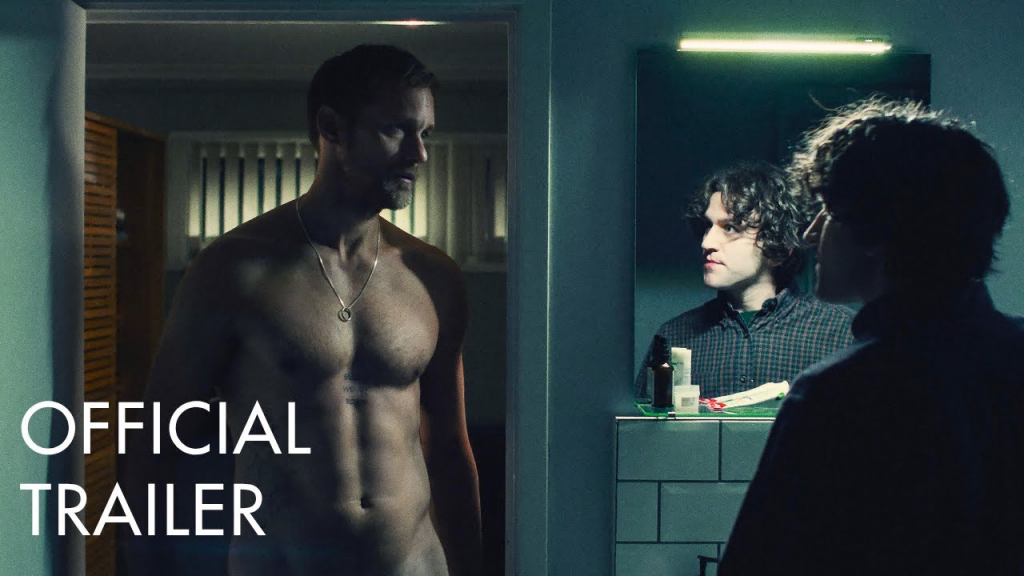
There’s even a tiny detail almost few have noticed: the three tattoos in his epigastric are are women’s names, and the last one—“Rosie”—is also the name of his cis dog. Maybe they’re exes, maybe they’re beloved dogs, maybe both. The film doesn’t explain. What we do see is a man with a past who finds it easier to inscribe attachment on skin, onto animals and myths, than to speak it out loud to a living equal.
Bravery
But what if Ray’s departure is also, in a twisted way, an act of bravery? Ray is not simply running from intimacy. He’s refusing to compromise a philosophy of life that, however flawed, is genuinely his. He has chosen asymmetry, ritual, leather, tribe. Colin’s kiss represents the gravitational pull of what Lauren Berlant called cruel optimism: a desire that is actually an obstacle to flourishing. Cruel optimism describes our attachment to fantasies of “the good life”—enduring reciprocity, coupledom, domesticity, and “happily ever after”—even when those fantasies are structurally incapable of delivering what they promise. When Colin asks “Isn’t love the whole point of everything”, he’s articulating the cruelest optimism of all: the belief that romantic love, in its conventional form, is the universal solvent for human need. “That’s not what this is,” Ray’s refusal to accept that premise isn’t sociopathy—it’s a philosophical position. He sees the couple form as a cage, and he’d rather be alone than locked in it.

This is where I find myself thinking about queer theorists who have very different fantasies of what refusal can mean. On one hand, Lee Edelman’s No Future frames queerness as a refusal of “reproductive futurism” and the mandate to be redeemed by love, legacy, or self‑improvement. In that light, Ray’s exit looks like a sinthomosexual gesture, a deliberate choice of exile over being folded back into the couple plot. On the other hand, José Esteban Muñoz and Leo Bersani both insist that refusal and self‑shattering don’t have to end in solitary ruin: Muñoz points toward queer collectivities and futures, and Bersani reads sex’s “radical disintegration” of the ego as an opening into new kinds of relation rather than a death sentence. The campfire scene, where Colin jumps among the bikers with genuine, childlike happiness, is a Muñozian moment: a glimpse of queer belonging that is not reducible to the couple form but is deeply, communally relational. It’s a form of queer intimacy and belonging that doesn’t look like Mom and Dad’s marriage, and that Ray helps build and then abandons.
I’ll say more about that tension, and about what Colin’s parents think “the good life” looks like, in a future post. For now, here’s what I think Pillion is doing with Ray’s departure, and why it matters for us:
Ray is simultaneously all three things—cruel, cowardly, and brave. He’s cruel because he leaves without aftercare, without closure, without honoring the infrastructure he built, albeit far from perfect. He’s cowardly because he’d rather lose everything than sit in the vulnerability of being known. And he’s brave because he refuses to live a life he doesn’t believe in, even when the alternative is loneliness—even when the person he’s leaving is someone he clearly, painfully loves.
That tangle is what makes Ray more than a “toxic Dom” meme. It’s also what connects his exit to the consent question: Ray’s “you can leave” was always also “I can leave.” The formal freedom he offered Colin was the same formal freedom he reserved for himself. And in both cases, it was real enough to be exercised and hollow enough to devastate (I had to cut a section on consent in Pillion as it became too meandering. I may revisit it another day).
I’m aware that not everyone sees this density. One blogger argues that Ray is “purposefully presented as having no other dimension to him than his Dom persona and his bike,” and that his vanishing act proves he has “no real depth of connection or accountability between him and the community.” That’s a fair criticism of the script (and the novel): we get almost no backstory, no confidant, no scene where he processes anything out loud. My own impulse, maybe as a nerdy doggo and overthinkinf horse, is to fill those silences with meaning—warrior myths, avoidant attachment, tattoos named for women or dogs. But it matters to say: the film doesn’t show Ray doing the relational work that would make those myths livable. Whether you read him as tragic or just hollow depends a lot on what you bring in.
Reading Ray as an Abuser

Before I get too enchanted with Ray’s mythology, I want to sit with a very different reading that I’ve heard from friends and community members—especially folks with a history of abusive dynamics.
A fwend who watched Pillion once, not twice, put it like this: “From beginning to end, I never thought he was a good guy.” They weren’t waiting for a reveal, or a tragic backstory, or a redemptive arc. Every time Ray failed to show up—skipping the funeral, withholding comfort, weaponizing silence—they didn’t experience it as surprising complexity. They experienced it as familiar. “I’ve been with abusers,” they said. “So when he didn’t come to the funeral, I wasn’t shocked. I just thought: yep. That tracks.”
Where I see a man torn between a philosophy of life and an unexpected attachment, they see someone who repeatedly chooses control over care. The “you can leave” line, for them, isn’t tragic or philosophical; it’s a classic move. Formally, it offers freedom. Functionally, it lands inside a relationship Ray has already structured so that leaving would mean losing everything Colin has built his new identity around. It’s not that the sentence is false—it’s that for someone so emotionally and materially bound to him, it isn’t really a choice.
From inside the leather world, Chris reads the film as a warning about the trend of new subs “jumping straight into CNC… despite not having a point of reference,” and sees Colin’s dynamic with Ray as “a rather one sided and intense D/s (I would go so far as call it a master/slave dynamic) relationship” that you shouldn’t start with if you don’t know your limits yet. His takeaway is simple: negotiation, check‑ins, and reassessments are not optional extras; “D/s has an inherent feedback loop… when this becomes truly one way the relationship fails regardless of the style of relationship.”
On the other side, Mr. Q makes a vital counterpoint: “Assuming a new sub cannot meaningfully choose submission is, ironically, a very paternalistic way of thinking. It strips us of the autonomy critics claim to defend. We don’t need to be ‘saved’, we need to be understood.” I don’t want a reading of Ray that turns Colin into a child, either. My aim is not to deny Colin’s agency, but to name the structures that make any “no” more costly than it looks from the outside.
My fwend also pushed hard on the question of compromise. In my more generous mood, I’ve argued that Ray’s refusal to compromise is a kind of integrity: he won’t pretend to want the dinner‑table romance the parents embody, he won’t dress like the rest of the gang, he won’t soften the asymmetry just to make other people more comfortable. But my fwend’s response was blunt: “If Ray couldn’t compromise with Colin, who was already doing so much of what he wanted, I can’t imagine anyone he could have a healthy relationship with.” If one’s “authentic life” only works when other people erase themselves, at what point does it stop being a philosophy and start being a pathology?
They took the Ray’s return‑to‑the-code logic somewhere I hadn’t. For them, Ray’s whole project—the fantasy of a purer life, a stricter code, a tribe living “the right way” while the rest of the world is wrong—rhymed uncomfortably with other purity fantasies: “better ways of life,” “back to the motherland,” the seductive promise that if we just purge enough softness, enough compromise, we’ll finally be clean. It’s not that Ray is a Nazi; he isn’t. But the structure of his dream—unbending, unshared, and ultimately incompatible with mutual flourishing—rings alarm bells if you’ve seen where those kinds of myths can lead.
On the level of the film’s emotional arc, my fwend didn’t experience the ending as sad at all.. They felt relief. Relief that Colin stated his boundaries. Relief that the relationship ended. Relief that the story gestured toward the possibility of a future where Colin could seek D/s dynamics that is intense but not annihilating. When I told them some people found the ending heartbreaking, they just shook their head: “I was happy for [Colin]. The mom was always going to die. The real win was that he got out.”
This reading matters. It doesn’t cancel mine; it complicates it. Where I see a tragic, philosophically committed Dom who can’t live inside the compromises intimacy demands, survivors see a familiar pattern of neglect and control. Where I’m tempted to romanticize his refusal to bend, they remind me that some refusals don’t deserve to be romanticized.
Between Chris’s verdict that “Ray, as a Dom, is only focused on what HE gets out of the relationship,” my survivor fwend who “never thought he was a good guy,” and Mr. Q’s insistence that the relationship is transformative but not purely abusive, you can see how differently kink‑literate viewers slice this. I find myself somewhere between my fwend and Mr. Q. I don’t think Ray is a monster, and I don’t think his dynamic with Colin was “fake” just because it wasn’t sustainable. As Mr. Q writes, “Not every love that changes us is sustainable. Not every relationship that helps us grow is meant to last. But when we’re in it, it’s still love nonetheless.”
For me, Ray is a Dom in progress: someone with the courage to reject the scripts offered to him, and the cowardice to flee rather than learn how to love without absolute control. He’s cruel. He’s cowardly. He’s also brave in ways that are hard to admit. Holding all three truths at once is the uncomfortable work this film asks of us.
So I want to leave Ray there: as fascinating, myth‑driven character whose sadness at the end feels real and earned, and as, for many viewers, the kind of partner they never want to be near again. Any attempt to read him as a tragic hero has to make room for that recoil, not argue it away—and it’s that clash between philosophies of kink, love, and “the good life” that I’ll turn to next, when we talk about Colin’s parents.
-

Reading Ray: A Kink-Affirming Analysis of Pillion (2025)
A queer, kink-affirming, trauma-informed reading of Ray in Pillion (2025)– part tragic Dom, […]
-


No responses yet